Vacheron Constantin Celebrated Time And Invention In Paris And Geneva
The 270th anniversary event was a fabulous display of the many facets that have contributed to the watchmaker’s legend.

At the Louvre—which attracts approximately nine million visitors per year, many of whom are there for a view of Leonardo da Vinci’s enigmatic Mona Lisa—room 602 at the Sully Wing was very recently redone, with a congregation of artifacts devoted to mankind’s quest in measuring time.


Here, the museum’s department of decorative arts pays tribute to ‘artful mechanics’, including time-measuring instruments dating back to ancient Egypt, a peacock-shaped automaton clock from medieval Andalusia, and European time-measuring inventions from the 16th to the 18th centuries. Looking down at this collection of objects is the portrait of Louis XIV, the Sun King, whose decision to move royal residences to the Palace of Versailles enabled the Louvre Palace to become a display for the royal art collection.

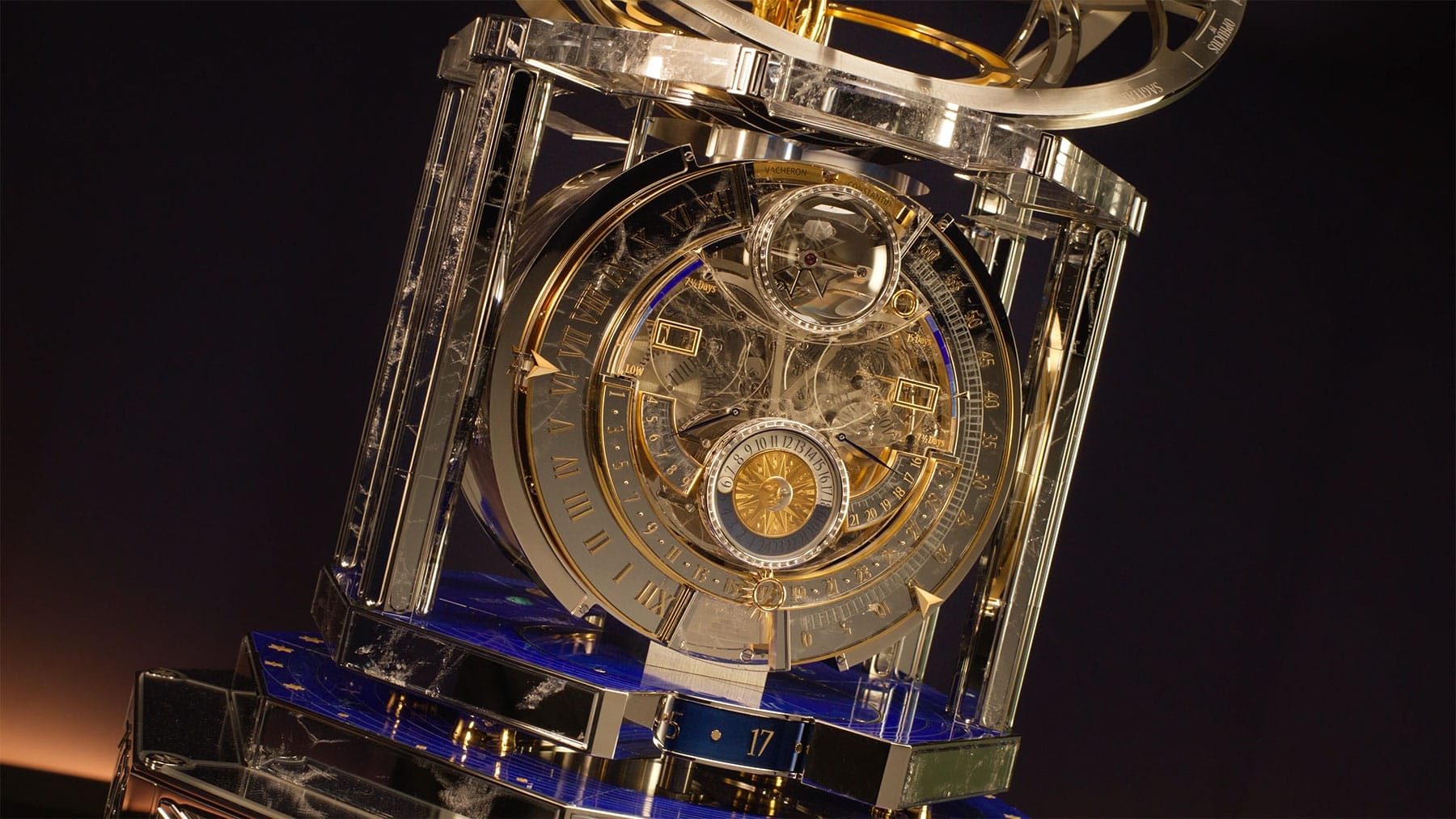
And, right at the centre of the room, one finds Vacheron Contantin’s Grand Project commemorating the maison’s 270th anniversary. La Quête du Temps—seven years in the making—is a union of three universes, that of automata, watchmaking excellence, and decorative crafts. Its clock is powered by Calibre 9270, composed of 2,370 components and 23 complications, including astronomical functions. Calibre 9270 also moves La Quête du Temps’s gilded astronomer automaton through 144 fully mechanical gestures.

Meanwhile, the work of Vacheron Constantin’s jewellers and precious metal artisans is most evident on the solar system representation on the object’s plinth, a background of lapis lazuli, while planets are depicted with cabochons and mother-of-pearl inlays. In all, no less than 17 different types of stones are featured on this, with historical crafts such as guillochage employed to heighten its artistic merit.
La Quête du Temps, at a metre high and 250kg in heft, will continue to be on display at the Louvre until 12 November this year, and represents a triumph of 6,293 components powering an intricate mechanical wizardry. Next to it, one also finds the timepiece known as ‘the Pendulum Clock of the Creation of the World’, a masterpiece of horology in precious metals that benefited from Vacheron Constantin’s contribution, aiding its 2017 restoration. Over time, Vacheron Constantin’s continued relationship with the Louvre also birthed a mentorship programme in collaboration with the Louvre’s art workshops in 2019.

“Man thinks that if we can count time, we can master time,” was the introduction by the museum curator to the assemblage of watch journalists who had gathered at the Louvre that morning, before the doors had officially opened to visitors. At its viewing, Christian Selmoni, Vacheron Constantin’s style and heritage director, remarked that La Quête du Temps is a very human adventure, in which the maison’s creativity and craftsmanship transmit real emotions of witnessing magic unfolding before your very eyes.
Just the night before, a cocktail reception at the modish Philantro Lab saw Vacheron Constantin’s CEO Laurent Perves speak of the maison’s longstanding ethos: “Do better if possible, and that is always possible.” This motto was first used in a letter from co-founders François Constantin to Jacques-Barthélémy Vacheron on 5 July 1819, and has since become the company’s guiding principle. “At Vacheron Constantin, the pride and emotion we feel with each new project comes from the freedom and passion to create, which is fuelled by the quest for excellence and innovation,” Perves said.

As part of the programme coinciding with the launch of La Quête du Temps, Vacheron Constantin also brought together Selmoni, as well as Olivier Gabet, the director of the Louvre’s department of decorative arts, and Christophe Galfard, writer and astrophysicist specialising in black holes and the origin of the universe, who also happens to be a former student of Stephen Hawking.

Here, at the salon Pompadour of the historic Le Meurice hotel, the panel discussed the marriage of art and science, and the idea of time in relation to philosophy and astronomy. Galfard, on his part, undertook a quickfire explanation of time in the Newtonian context and through Einstein’s theory of relativity. “What is absolutely crazy when we understand that time is not the same everywhere, is that time can have a history—and in this we could say that we invented a time that suits our needs, to be able to plant seeds and pray, and predict the next sunrise.”

In response, Selmoni stated: “We are already in the 21st century—and we know the digital ecosystem is reducing slightly the free time we used to have in the past. So, I think this reality, in which everything has to be new, tomorrow morning it won’t be new anymore, and, a week later, it’s obsolete. It creates a paradox when we bring back the notion, which is, you have to give time to time.” In this sense, Selmoni credited La Quête du Temps to the intelligence of the human hands—the notion of working by creativity and craft to realise this exceptional object—and to enthral generations to come in their quest to understand, measure, and master time.


That very same evening, an estimated 180 guests dined inside the Louvre, under the iconic I.M. Pei-designed pyramid in the museum’s Richelieu wing, which showcases French sculptures the likes of the Roman sea god Neptune and his wife Amphitrite. As the evening segued from the percussive beats of a music quartet to interpretive dancers denoting the ethereal nature of time, diners were also presented with a ‘star certificate’, signifying that Vacheron Constantin had named a star in each and every guest’s name with the International Space Registry.
The next day, the party moved from Paris to Geneva onboard personalised TGV carriages—a much smoother journey than the 17th-century trek that French Huguenots undertook to flee France in the time of Louis XIV, who had enforced Catholicism upon the populace. As time, and history, would have it, the influx of persecuted French Huguenots brought clockmaking and decorative arts across the Alps, contributing to the rise of Switzerland as the cradle of watchmaking.
And so, precisely 270 years to the day when Vacheron Constantin was founded, on 17 September in 1755, the manufacture celebrated its anniversary, now with the added cachet of being the world’s oldest watch manufacture in continuous production. Its heritage is also signposted by astounding world records, having produced some of the most complicated timepieces known to man, including this year’s newsmaker and the current world record for most complicated wristwatch: Les Cabinotiers Solaria Ultra Grand Complication – La Première, which has 41 complications.

In the approach to the Vacheron Constantin manufacture located at the outskirts of Geneva, under pink gold-tinted skies of late summer, the prevailing sense was one of anticipation. Guests would then arrive for the gala dinner at the manufacture’s main building, welcomed by a guard of honour of lab-coated watchmakers and members of staff. Entering the manufacture’s lobby revealed even more members of staff in a synchronised dance to piano riffs and jazzy singing.
Cocktails then took guests through a meandering journey of the manufacture, from its hall of fame displaying all the names of employees who have served for more than a decade, to the incredible wealth of vintage clocks and showstopping timepieces from its own museum. All through its workshops, the jazz musicians played on, with dancers adding to the sublime sense occasion.
For many in attendance, the veritable trove of treasures unearthed by Vacheron Constantin bordered on unbelievable thanks to the phenomenal display of timepieces ranging from a 1947 ‘Les Amourex’ enamel pocket watch in a yellow gold hunter case to a 1940 Art Deco table clock of onyx, marble, and lapis lazuli by jeweller Jacques Lacloche and powered by the Vacheron Constantin 408025 movement. The biggest gasps were saved, of course, for the Reference 57260, nonchalantly gleaming in its window case—the previous holder of the most complicated pocket watch in the world, and surpassed only by The Berkley Grand Complication (also produced by Vacheron Constantin’s Les Cabinotiers).

As the guests were seated within a grand dining room, projections of the watchmaker’s movements were beamed onto the plateware, tables, and walls. The evening was a roaring celebration of cuisine—as presented in the four-course meal by Chef Michel Roth (Meilleur Ouvrier de France and Bocuse d’Or) of the one-Michelin-starred Bayview restaurant in Geneva—of music and dance, and, definitely, of horology, with the continually changing illumination of the manufacture.


The evening would keep going with a DJ set, and plenty more revelry, as guests soaked up one of the best anniversary parties ever held by a watchmaker in recent memory. And, under the cloudless night sky, the stars above Geneva shone brightly against the velvety black—much like how Vacheron Constantin’s watchmakers gazed upon the very same sky in 1755—that served as a reminder of mankind’s eternal quest for new horizons and excellence in all forms.
You May Also Like