

Ferrari Reveals Interior Details and the Official Name of Its First EV (It’s Not Elettrica). Here’s What to Know
The cabin’s key components are styled by Apple’s former head creative, Sir Jony Ive, and fellow icon of industrial design, Marc Newson.

Ferrari’s legacy has been built on frequently redefining the crossroads of automotive form and function at the highest level. Its benchmark models have been the result of collaborations with such carrozzeria as Touring, Pininfarina, and Scaglietti, with results ranging from the 166 MM to the 250 GT to the 275 GTB, to name a few from the last century.
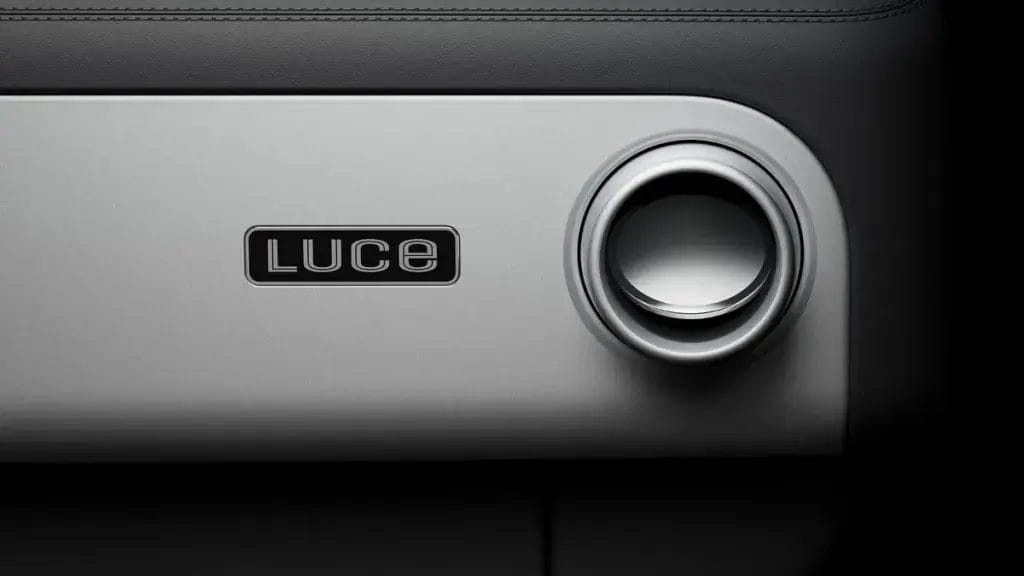
So far this millennium, Maranello’s most important partnership has just been revealed to be that with LoveFrom, the design house led by the ground-breaking creatives Sir Jony Ive and Marc Newson. The project? The first all-electric Prancing Horse, now with its name officially debuted as the Ferrari Luce, which translates from Italian as “light.”
Ferrari S.p.A.
Last week, Robb Report was invited to San Francisco, where LoveFrom is based, for a full-day briefing with Ferrari’s top executives, Ive, and Newson at the TransAmerica Pyramid building. This was the second phase of a time-released premiere that began four months ago in Maranello. That initial session comprised a limited unveiling of the EV platform for the car, which was then going by the rather unimaginative moniker Elettrica (we should have known that was just a working title).
This next dose of insight, delivered in the Bay Area, pulled the cover off the cabin’s primary interior components. These include the steering wheel, the binnacle and its instrument cluster, the control panel, the key and key dock, the central console, and the seats.

Ferrari S.p.A.
“You will see, in detail, what’s inside the car and how the driver will relate to the car, and I think you will be surprised at the level of innovation that the team has brought to the car,” stated Benedetto Vigna, Ferrari’s CEO, to start the day. Perhaps most surprising was the fact that two such prolific outside designers played such an integral part. Especially considering that Ive was largely responsible for sculpting today’s zeitgeist when it comes to humanity’s adoption of tech due to his three decades of seminal work with Steve Jobs and Apple as its chief design officer. As such, he was instrumental in the development of such ubiquitous products as the iMac, the Apple Watch, and, most revolutionary, the iPhone.
When it comes to his work on the Luce’s interior, Ive had a principal starting point. “I never understood why, if the power source was electric, why does it follow that the interface be digital? I think that’s a bizarre and lazy assumption,” said Ive. “I think, particularly, as the power source affords an incredible set of opportunities, we are missing some things that we love about our old Ferraris. And so it was very clear to us that we needed to figure out as many ways as possible to viscerally and physically connect to the interface.”
Ferrari S.p.A.
For Newson, as with Ive, the opportunity paired seamlessly with a lifelong passion for automobiles. “We’ve judged at all sorts of concourse events. We collect cars. I know we share very, very fond stories and memories of having restored vehicles when we were children and teenagers in England and in Australia,” mentioned Newson. “The opportunity to work with Ferrari together is a really incredible and unique one.”
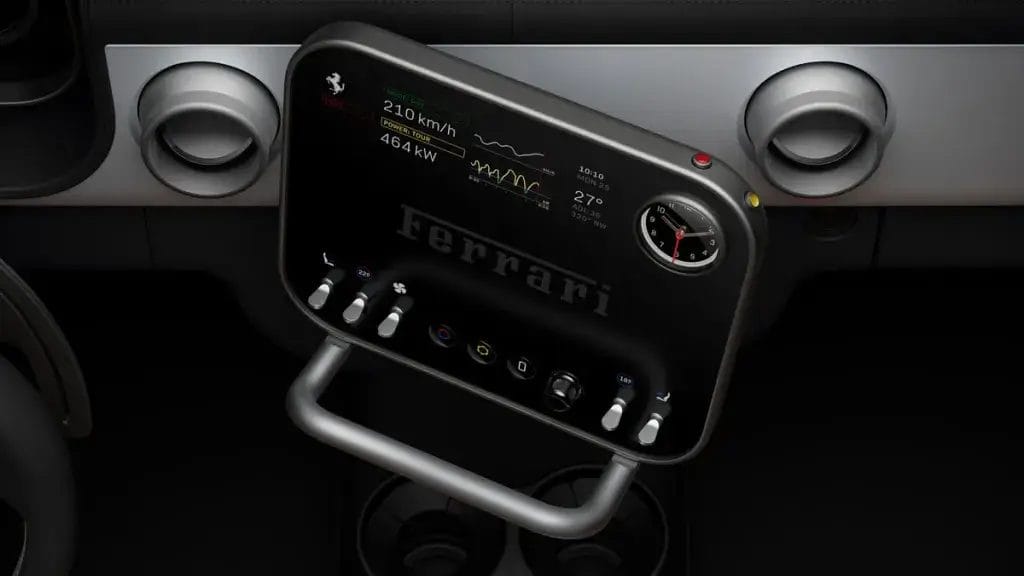
As we entered an exhibition space on the 27th floor, what captured the collective attention was not the stunning views of the city, but the Luce’s interior elements displayed with museum-like prominence that added a depth of drama. The first display encountered was that of the steering wheel, binnacle, control panel, and central console. LoveFrom has managed to balance analogue and digital with precisely machined aluminum toggles and glass buttons working in unison with electronic displays.
Ferrari S.p.A.
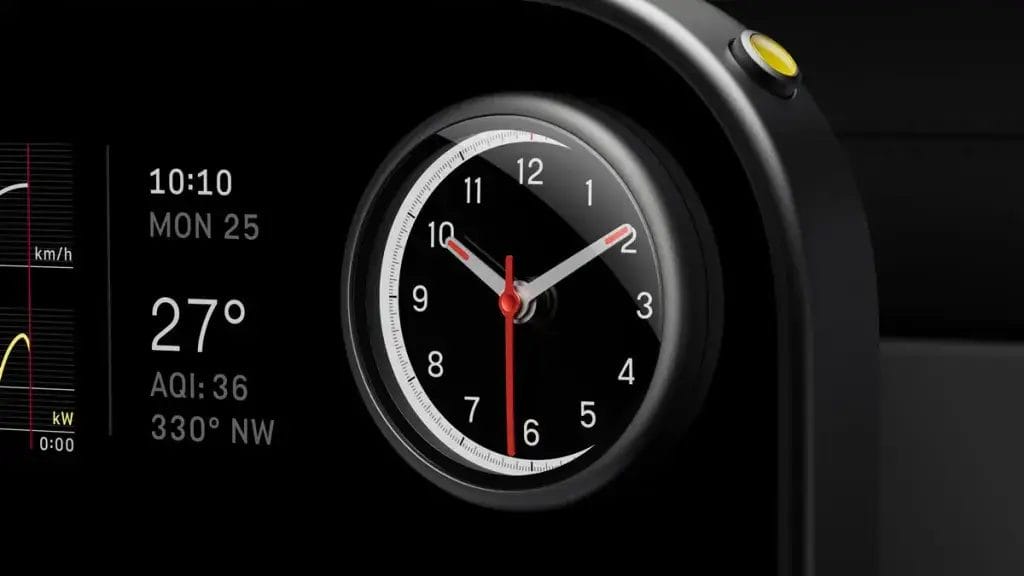
This juxtaposition is most artfully accomplished on the control panel, especially with what Ferrari refers to as the “multigraph” display. The latter can alternate between a conventional watch face, a chronograph, a compass, and the car’s launch-control indicator. Yet while each of the aforementioned are digital displays, the three hands are crafted from anodised aluminum and are driven by three motors and intricate gearing. “This has never been done before,” Ive explained to Robb Report regarding this particular analogue feature. “There’s never been hands that move independently of each other, there’s always a relationship.” These, however, do just that. At the same time, aluminum switches control climate, seat comfort, and the fan.
Also innovative is the handle at the base of the control panel that allows you, or the front-seat passenger, to swivel the panel in either direction, but it also aids in ergonomic ease and efficiency. “It’s common sense, but something that’s bizarrely ignored,” noted Ive. “It’s very hard to hold your hand out if you’re moving and find a button. And so, honestly, this is its primary function, a handle, but it’s [also] a palm rest, it gives you a datum that, without looking, you know that your palm is here, and therefore all of these lovely physical switches you don’t really have to even look at. You can feel where they are.”

Ferrari S.p.A.
As intuitive, and equally arresting visually, is the steering wheel and binnacle configuration. What initially stands out is the fact that the binnacle is affixed to the steering column so that it adjusts correspondingly with the wheel position, both with respect to vertical orientation and tilt. For the instrumentation cluster itself, the marque worked closely with Samsung and its OLED technology for the all-digital gauges that, according to Ferrari’s official press release, are representative of those from Veglia and Jaeger that were de rigueur on Ferrari models from the middle of the last century. The depth of field is enhanced by the fact that there are actually two layered displays. The panel below presents the speedometer, tachometer, odometer, and G Force measurements, which appear as separate gauges thanks to the top display’s three cutouts, each covered by its own convex glass lens and surrounded by a ring of anodised aluminum.
The steering wheel itself is a balancing act of future-forward functionality and traditional styling. “I have a [Ferrari] Europa from 1950 that has the classic steering wheel,” mentions Ive. “How do you keep the structure of a three-spoke wheel? How do you maintain the integrity of the three-spoke and then start to add these little modules?” That was the question Ive rhetorically asked as he walked us through the wheel design. Those “modules” house the selector knob for what appear to be the Range, Tour, and Performance EV modes on one side, while the manettino for Ice, Wet, Dry, Sport, and ESC off modes, along with suspension and wiper settings, exists on the other. Yet the elegant minimalism of the three spokes—made completely from recycled aluminum—remains the overarching aesthetic cue.

Ferrari S.p.A.
The ubiquitous use of Corning glass for all the displays and buttons is also a hallmark of the Luce’s interior, showcased significantly in the central console. Symbolic of the amount of thought, time, and materials that have gone into the Luce in general is the key and key dock system, as well as the shifter. The small rectangular box of a key is made of what’s touted as Corning Fusion5 glass that features the use of electronic ink (“E Ink”). The latter initially presents in Ferrari yellow until it is depressed into the central console, at which point the key turns black, the top of the glass shifter turns yellow, and all the instrumentation activates.
The glass shifter alone is a work of art that necessitated 13,000 laser-drilled holes at the top to ensure the correct illumination. And developing the shifter’s distinct tactile action as it moves between the selections of Park, Reverse, Neutral, and Drive, was also deceptively difficult. “We spent, I would say, four months just working on what this should feel like,” Ive told Robb Report.

Ferrari S.p.A.
When it comes to the seats, the standalone examples we saw looked to be sculpted tributes to those found in the Daytona, but with LoveFrom’s flair. “Mark’s reputation as a furniture designer is peerless . . . we’re ever so proud of the simplicity, hopefully, in the elegance, and the beauty of the seats,” stated Ive.
“We’re car nuts . . . we’ve got Ferraris. We love them, and we understand what’s important,” Newson told Robb Report. The biggest challenge for us is that this isn’t just another Ferrari, it’s electric, and that was a big, big, big thing to take into account.”

Ferrari S.p.A.
Newson’s sentiment is shared by that of Ferrari’s own chief design officer, Flavio Manzoni. “The wish of my team was to somehow imagine this car so different from the other Ferraris,” Manzoni mentioned to Robb Report. “But when John [John Elkann, Ferrari’s executive chairman] came, and we had some conversations about the idea of involving these two gurus, I thought, ‘Ok, I understand.’ This is such a unique technology that also deserves a unique form.”
The head Ferrari designer’s embracing of Ive and Newson as part of that process was, according to Manzoni, because the duo and their team at LoveFrom introduced “a universe of form that is totally different.” How brilliantly the Luce reflects these disparate design worlds will ultimately come to light when the completed car does, which will be in May.
This story was first published on Robb Report USA.
Lead image courtesy of Ferrari S.p.A.
You May Also Like


