How Traceable, Responsibly Sourced Gold Could Reshape the Future of the Industry
Steeped in the gold industry for generations, the Betts brothers believe it’s time investors and consumers alike know exactly where their precious metals come from—and they have a compelling case.

Back in 2006, British entrepreneur Dan Betts ventured deep into the Liberian jungle looking for gold. But it wasn’t just fortune he was after. “It was the romance and the adventure of wild places and wilderness, and that’s what always attracted us,” he says. That spirit led him to cofound Hummingbird Resources a year earlier, which began as a grassroots exploration company and today operates mines in three West African countries.
He acknowledges it was risky business going into the Liberian jungle “where nobody had actually systematically looked before,” and adds, “To be honest, we didn’t really have a clue what we were doing, but then even a blind squirrel sometimes finds a nut.”
Betts literally struck gold in Liberia, finding a significant deposit in the Dugbe Shear Zone. At over 3 million ounces, it was the largest gold discovery in the country’s history and a potential game changer for its economy. But he couldn’t secure the roughly US$600 million needed to develop the site. Undeterred, he continued prospecting in southern Mali, where he eventually bought the newly discovered Yanfolila reserve, a decision that would reshape his view of mining.
Archie Brooksbank
As Betts and his younger brother, Charlie, began developing the mine, they began to realise the weight of the responsibility they carried. “It suddenly dawned on us that if this gets developed the wrong way, we’re going to be responsible for devastating the environment and exploiting people in the wrong way,” he says.
Now 50, Betts stepped away from Hummingbird in 2024, but his conviction remains. “I think mining is the most powerful industry for uplifting poor communities and environments where nobody else is…. [They’re] out in the wilderness, you’re the only profit centre,” he says. “If you do it responsibly, you can have a monumentally positive impact—socially and environmentally.”
For Dan and Charlie, 46, gold isn’t just a business; it’s a legacy. They are the ninth generation of a family that has been refining precious metals since 1760, when Alexander Betts founded Betts Refining in Birmingham, England. But it was over beers in 2017—just as the Yanfolila mine went into production and its positive impact on the surrounding community became undeniable—that the brothers decided it was time to rethink the narrative around gold mining.
It’s estimated that about 40 per cent of all gold mined each year goes into jewellery and watches, and another 40 per cent goes into investment products (bars, coins, and bullion). The remainder powers industries like electronics, medicine, and aerospace. Yet, as Charlie Betts points out, only about 4 per cent of the world’s gold is traceable.
Gold is challenging to trace because once it’s mined, it goes to refineries where it is melted down and combined with metals from countless other sources—a process that erases its country of origin.

Courtesy of SMO gold
According to Charlie, many refineries claimed true traceability was impossible, because it must be co- mingled. “We knew that wasn’t true, because we have a refinery,” he explains. “It’s not difficult to segregate gold through a refining process, and we were prepared to pay the premium for that segregation.”
The brothers wanted to show that traceable, responsibly sourced gold wasn’t just possible—it was scalable. Their proof of concept came with Yanfolila, the first Single Mine Origin–accredited mine. It proved to them that they could source responsibly mined gold from large-scale mines and keep it segregated at the refinery level. They were determined to share that story with jewellers, investors, and anyone who touched gold, which, it turns out, is just about everyone.
While some jewellers have turned to Fairtrade and Fairmined gold, those certifications apply only to small-scale artisanal mining, and often come at a premium, notes Charlie. He points out that while Fairmined gold comes from responsible sources, the production is small and not always consistent: “We have a much tighter control on the chain of custody and pay for segregating at the refinery and monitoring, but it’s only about 2 per cent [more].”
In 2018, the Betts brothers established S.M.O. gold, a system designed to make gold traceable from mine to market. Every batch of S.M.O. gold is verified through third-party chain-of-custody audits, assigned a unique serial number, and comes with a QR code that allows buyers to see exactly which mine it came from.
The result is traceable 99.9 per cent pure 24-karat gold that can be used in jewellery and watches or kept as investment bars and coins with full transparency built in. That transparency addresses a long, complicated legacy in gold mining. In many regions, the trade is rife with exploitation and environmental hazards. Toxic chemicals are used to extract gold from rock, and it’s often sourced in remote locations where it’s easy to operate illicitly.

Archie Brooksbank
The issue has only intensified as gold prices have surged. As of press time, prices are hovering around US$4,400 per ounce, about double the price just two years ago, drawing the attention of criminal groups looking to abuse the land and the local people for considerable profit.
Hannah Porada, an expert in environmental justice at the Dutch branch of the International Union for Conservation of Nature (IUCN), says the consequences are severe. In some Latin American countries, she explains, organised criminal groups who are involved in illegally clearing the Amazon rainforest for cattle herding or narcotics trafficking are the same groups dealing in illegal gold.
“In Colombia specifically, but also other Latin American countries, the level of violence is really high,” says Porada, while also pointing out the significant human rights violations and infringement on indigenous territories as a result of illegal gold mining. “Then you have severe environmental impacts because most illegal gold mining goes hand in hand with the use of mercury,” she adds. “So you have extreme toxic pollution of rivers and severe health impacts.” She cites an estimate that about two-thirds of Colombian gold is mined illegally.
“Traceability is the only real way of supporting the reduction of our environmental impact and ensuring that [gold] flows are not polluted, illegitimate, or illegally sourced,” says Valerie Messika, whose eponymous Paris-based jewellery brand began using S.M.O. gold in January last year.
Charlie and Dan Betts acknowledge that mining is far from perfect. “You’re digging a hole, it’s a finite resource, there’s chemicals involved,” says Charlie. “But, in my opinion, if you do it right, the beneficial impact massively outweighs the negative. Mining in some of these countries is an unparalleled sector for development.”
Next-level Gold
The S.M.O. process begins with identifying mines that meet rigorous environmental, social, and governance (E.S.G.) benchmarks, aggregating annualised data across 14 criteria and comparing gold mines worldwide. To date, the Betts brothers have taken data from over 200 gold mines, tracking carbon emissions per ounce of gold produced, recycling statistics, percentage of local employment rates, percentage of profits going back into the community, and more.
Currently, S.M.O. is sourcing gold from the Ity mine in Ivory Coast and Sabodala-Massawa in southwestern Senegal, both owned and operated by Endeavour Mining, as well as from Australia’s Bellevue, the world’s first net-zero-emissions gold mine.

Archie Brooksbank
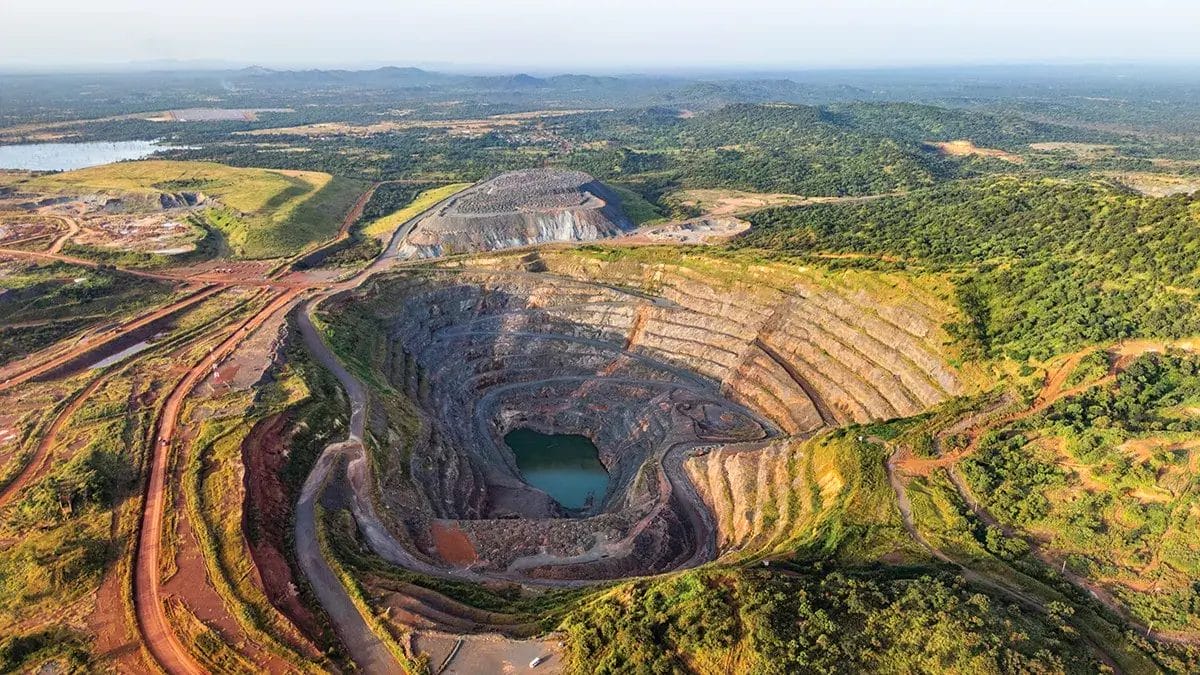
During a visit to Sabodala-Massawa last October, Charlie Betts invited Robb Report and three jewellers committed to using S.M.O. to see the operation first-hand. After a two-hour flight from Dakar on a small prop plane, we landed on a desolate dirt path surrounded by bushland, where monkeys lumbered across the fields. In the distance, the expansive open-pit mine came into view, an immense landscape lined with massive tractors hauling gold-rich ore to the processing plant.
There, the ore is ground into fine powder and transferred to large tanks, where it undergoes either a bio-oxidation process—using naturally occurring bacteria to break down sulfide minerals and release gold or the traditional C.I.L. (carbon-in-leach) process, in which a cyanide solution and oxygen dissolve the gold for recovery. Next, the separated gold is poured into 28-pound bricks, each worth roughly US$800,000, and flown to Switzerland’s Metalor refinery.
The Endeavour gold is segregated from other sources, refined, and sent to the Bettses’ refinery and other casting houses—stamped with a serial number and accompanying QR code for verification.
Giving Back
At Sabodala-Massawa, 62 per cent of water is recycled, 67,000 panels for a solar farm are under construction, and in 2022, it set aside about 3,700 acres on its mining permit to protect the West African Chimpanzees.
In the only nearby village, where tribespeople have lived off the land for generations, Endeavour and the S.M.O. Foundation established a clinic in 2024 to support maternal, neonatal, and child health.
It’s these visible, measurable initiatives that are inspiring jewellers to embrace the S.M.O. story and share it with their clients. “Having been to the mine, it’s lovely to think that I’ll be able to tell all the shops, when I go around them [to speak] to all the sales staff, that we can hold our heads up high and know that we’re sourcing our gold from a good place and there’s a positive social impact,” says James Amos, managing director of Boodles, the British jewellery house that has done business with the Betts family for several generations. In 2021, Boodles made the bold move to shift its entire gold production to S.M.O.

Archie Brooksbank
For London-based jeweller Emefa Cole, known for her sculptural gold pieces, the appeal is personal. Although she has lived in the United Kingdom for the majority of her life, as a native of Ghana, she sees ethical sourcing as a way to protect her roots. “The origin of the metal I use keeps me connected to my land [and] region of origin, and I care deeply about the source as well as the communities [where] the materials I use come from,” Cole says. On the trip, she witnessed firsthand Endeavour’s commitment to their 1,532 local employees, 93 percent of whom are covered by a collective bargaining agreement.
“I have been using S.M.O gold since I became aware of it during 2020,” she says. “It was very special for me to finally be able to see and interact with the people who make it possible for me to create [with it]. The miners and refiners and Mother Earth are a crucial part of every piece I create because their work and efforts enable me to have access to the materials essential to my practice. I do need to make work that sits right with my soul because anything other than that would be futile.”

Archie Brooksbank
Emerging British jeweller Shola Branson agrees, though for different reasons. “There’s been a lot of green-washing in the industry, specifically around recycled gold,” says Branson. “Consumers think recycled is better than extracting more gold from the earth. There’s an unknown amount of gold that’s claimed to be recycled, cut with gold from dubious sources, which may have used mercury in the process.”
The problem is that the legal definition of recycled gold is murky, explains Porada. “If you extract gold illegally and you refine it once, you can declare it as recycled gold,” she says. “So there is a major loophole, and consumers might believe they are buying ethical or sustainably sourced gold, whereas in fact they [are buying] gold that has just been illicitly mined or mixed with other gold coming from elsewhere.”
The Future of Traceable Gold
The S.M.O. gold concept is gaining momentum, but transforming one of the world’s oldest and most opaque industries won’t happen overnight. Although many jewellers want to participate, shifting long-standing supply chains can be complex. Larger houses often work with multiple casters and suppliers, making the transition to fully traceable gold a logistical challenge.
Still, the results are encouraging. In 2024, the Betts brothers sold 417,000 ounces of S.M.O. gold (about US$1.7 billion) into the financial sector, and another 6,000 ounces (about US$24 million) onto the jewellery market. Their goal is ambitious: to make S.M.O. gold 40 per cent of the jewellery industry’s gold by 2030. But because they are working with large mines, Charlie says he believes it’s a scalable proposition.

Courtesy of Shola Branson
However, while the World Gold Council (WGC), an organisation representing leading mining companies, including S.M.O. partner Endeavour, supports the principle of traceable gold, it cautions against creating confusion in the market.
“The best thing for large-scale mining [is that it is] done in the harmonised way,” says Joseph Cavatoni, WGC’s senior marketing strategist, North America. He adds that, currently, even a large bar that the London Bullion Market Association (the international trade association that represents the market for gold and silver bullion) affirms is universally acceptable, is not necessarily up to S.M.O. standards. “What we would want to avoid is confusion at the point of purchase,” he says. To that end, the WGC has created 51 responsible principles and conducts independent annual audits to ensure compliance. It has also developed consolidated standards that align core industry groups, which are expected in early 2026. Among new initiatives: using technology to track and trace large-scale gold mines and creative ways to engage small miners. One promising model Cavatoni names is Montreal-based Dynacor Gold Mines, which he says processes ore from 750 artisanal miners in Peru under strict compliance standards.

Courtesy of Emefa Cole/Getty Images
After processing at Dynacor’s Peruvian plant, the gold goes to a refinery in Switzerland, where Cavatoni notes that brands including Rolex purchase the gold, with a portion of the profits flowing back to fund socio-economic development projects in Peru for artisanal miners and their communities.
This evolving landscape shows that traceability isn’t just a moral imperative; it’s becoming a business strategy, too. Increasingly, investors and brands are under pressure to align with E.S.G. principles, and consumers are demanding proof that their luxury goods do no harm.
That’s why in 2024, the Bettses established the S.M.O. Physical Gold E.T.C., a US$1.25 billion exchange- traded commodity fund, which they say is the world’s first fully traceable gold E.T.C. fund. “We want [investors] to know that by buying this gold, you’re buying something that is a force for good,” says Dan, adding that when done right, it is nothing to be ashamed of or considered dirty.

Courtesy of Boodles
He believes the next phase of the gold revolution lies not in new technology but in consumers demanding clarity on the source of their gold. “If consumers drive it, then the mining companies will be committed to performing to those standards, and they’ll want to engage in it as well. And then it could become a virtuous circle,” he says.
Betts acknowledges, however, they haven’t even begun to scratch the surface. “I mean, that’s a big, grand idea, but I think all the pieces are there,” he adds, driving home that it’s a win-win for everyone if they succeed. “Ultimately, why can’t it be an industry standard where it’s just the norm, not the exception?
This story was originally published on Robb Report USA.
You May Also Like