What It’s Like to Live Between Lives at Raffles’ Two Properties in Cambodia
Raffles Hotel Le Royal and Raffles Grand Hotel d’Angkor are places where history isn’t just kept—it is made.

Phnom Penh does not reveal itself in a single, digestible layer. It is a dynamic mosaic blanket, a city of overlapping identities where the jagged, sun‑glinting glass of the new Cambodia mirrors the weathered, yellowing stucco of the old. One navigates both by learning how to slide between eras, moving from the cacophony of central markets to the hushed corridors of history. But to step through the porte‑cochère of the Raffles Hotel Le Royal is to locate the city’s informal anchor. Here, dignity is a service standard that has survived a century of pomp, ceremony, glamour, and profound turmoil.
Established in 1929, Le Royal was birthed during a time when travel was a deliberate, slow‑motion art form—the era of steamships and overland expeditions. Today, it remains a rare space where the past is respected and hosted as a primary guest. One feels the weight of history in the cool monochrome floor tiles and the impossibly high, airy ceilings of its 175 rooms and suites—a time‑warp nature that allows for a rare, quiet reflection. You arrive at a place that has seen everything and judged none of it.


Beyond the hotel, gleaming skyscrapers cast long shadows over colonial‑era villas that have seen better days, their shutters hanging at rakish angles like the eyelids of a tired aristocrat. One inhales on the streets a cocktail of scents: charcoal‑grilled pork, sweet jasmine, and the metallic tang of rain on hot asphalt. Yet, as you retreat after the midday heat into the Raffles, your butler knows exactly what to do to take the sting out of the afternoon sun: a strong Cambodian iced coffee.
It was within these walls in 1967 that a certain American traveller arrived between two of her well‑documented lives. Jacqueline Kennedy came to Cambodia at a singular crossroads. She was no longer the First Lady of Camelot, but she had not yet taken the mantle of the global jet‑setting icon she would become. In Cambodia, she was seeking a world away from the flashbulbs of the West; in the late 1960s, the lack of commercial flights and the severing of diplomatic ties acted as a natural barrier to the era’s press corps. In relative privacy, one imagines Kennedy walked these halls with a softness and presence that respected the setting, the objets d’art, and the physical conciseness of the lobby.


Today, her visit is immortalised at the Elephant Bar, a wood‑panelled institution where the air seems thick with the secrets of diplomats, journalists, and the occasional cruise ship tourist. The Femme Fatale cocktail—a delicate, bubbling blend of champagne, cognac, and crème de fraise—pays homage to her stay. Sitting by the bar, surrounded by hand‑painted murals of pachyderms and the gentle whirr of ceiling fans, one can easily slip into the fantasy of a different time and place.
Dinner at the hotel’s signature restaurant, Le Restaurant Le Royal, continues the act of stepping back in time. We dine on Royal Khmer cuisine—simple yet elegant recipes passed down through generations of palace cooks. The Amok, typically a rustic coconut curry steamed in banana leaves, arrives elevated by opulent additions of lobster. The flavours are in perfect balance: creamy coconut milk perked by the citrusy zing of kaffir lime and the earthy depth of fresh turmeric.


My second‑floor room, located in a wing added in the early 1980s, is a grand private residence. The space features solid wood finishings and a bed reminiscent of the colonial era—sturdy, stately, and draped in standard‑issue Raffles linen. Yet, international adaptor plugs and USB sockets are positioned exactly where the hand falls. It offers the aesthetic of the 1920s with all the expected mod‑cons of our age.
My butler, Henry, a twenty‑something Cambodian, is always in step with what I need. His thoughtfulness manifests in small details: on my final night, alongside the bedside chocolates, comes a handwritten note: “Please remember to bring your comfort pillow when you check out. Pillow loves to travel too.” I am a creature of habit who carries a personal pillow on every journey, ensuring my neck and shoulders experience a sense of familiarity, even when my personality is stretched by the frantic geometry of having lived in three or more places at once.


Over dinner, general manager Dagmar Lyons shares her own affinities for the city’s evolving personality. Her tenure continues to be one of stewardship, ensuring the property remains the city’s heritage go‑to. At her suggestion, I take a tuk‑tuk tour through the French Quarter. We bypass the usual tourist traps to find the city’s architectural nodes: buildings with deep terraces that evoke Paris’s 18th arrondissement, their façades now softened by tropical vines, the patina of time, and the enthusiasm of a hawker selling fresh coconuts.
We stop at the Secondary School of Fine Arts, a site of immense gravity. In the late 1970s, the country’s cultural memory was under siege. More than 900 students and teachers here did not survive; with them, the ancient Apsara dance form—a celestial art that had existed for more than a millennium—seemed to vanish into the ether. For a time, perhaps it did. The costumes were burned, the music was silenced, and the masters were gone. It was a systematic attempt to erase the very DNA of a nation.
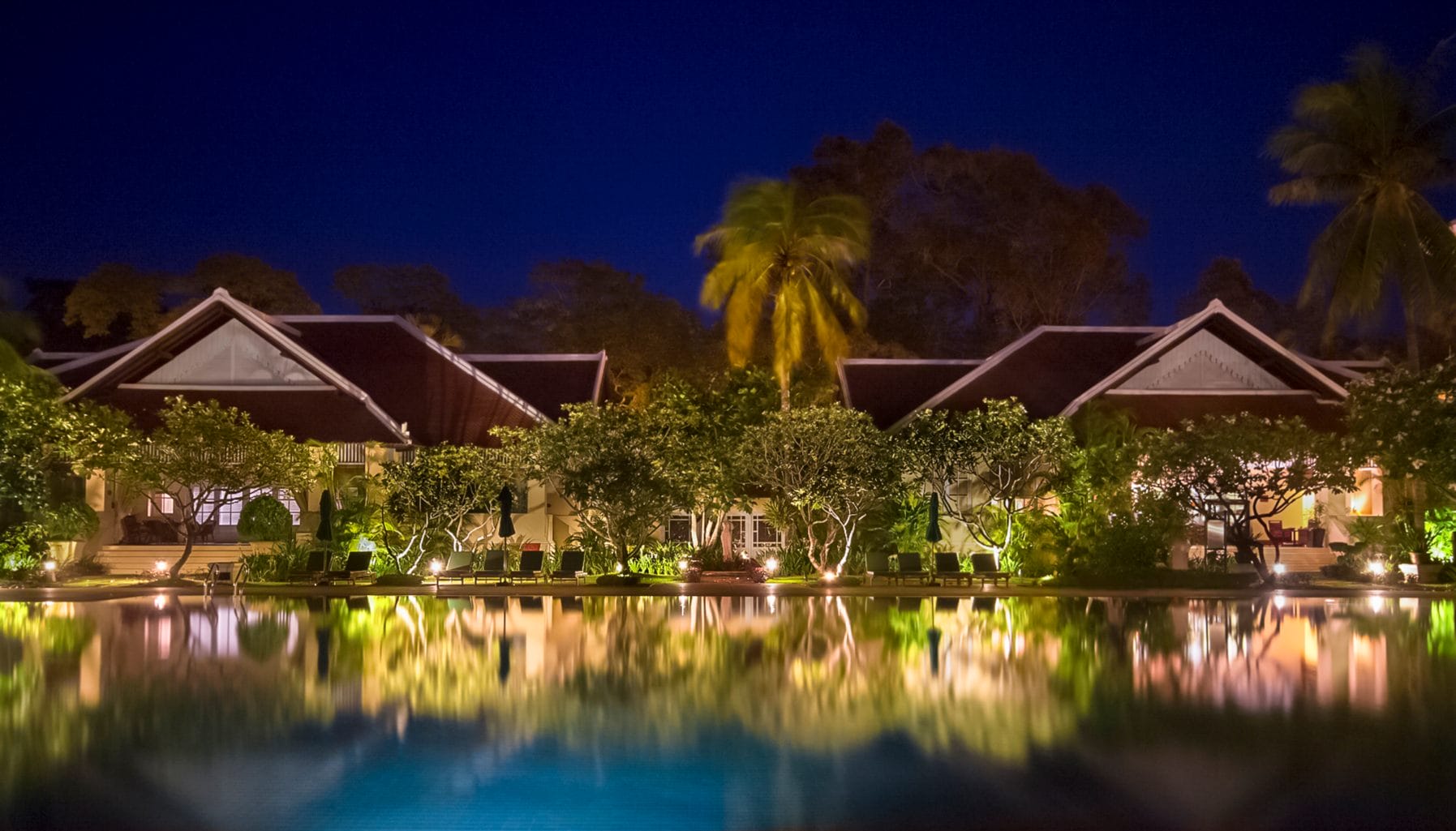
Our journey then shifts five hours north to Siem Reap, a drive revealing the rural heartlands of Cambodia—vast rice paddies and grazing water buffalo. If the Le Royal is the city’s heartbeat, the Raffles Grand Hotel d’Angkor is its quiet consciousness. Opened in 1932 to accommodate the first wave of explorers, it is no stranger to history. Set across 15 ac of manicured French gardens, the property is a landmark of Art Deco elegance, housing 119 rooms, suites, and villas. My room in the main wing is both refuge and history lesson, featuring the original timber elevator that still creaks with the weight of a thousand anecdotes.


This part of the trip centres on the launch of the book A Tale of Two Hotels by historians Andreas and Carola Augustin. In a meeting room that has undoubtedly hosted decades of high‑stakes negotiations, they explain their raison d’être as the biographers of the world’s most iconic hotels. Later that afternoon, general manager Joseph Colina launches the hotel’s new museum. His American New England accent cuts through the humid afternoon air—a crisp, Ivy League cadence that brings back a sliver of that 1967 Kennedy mystique, recalling the hotel’s long‑standing cultural flirtation with American royalty.
The ultimate bridge to the past requires a 4.45am start. We ride from the hotel on Vespas, the pitch‑black morning wind biting at our faces as we dive towards the temple complex. While scores of tourists huddle by reflection ponds for the ‘perfect selfie’, Raffles arranges an exclusive preview, allowing us to witness the temple’s awakening in a pocket of solitude. We watch the silhouette of the five towers emerge from the purple dawn—a reminder of why Angkor Wat remains one of the world’s greatest wonders.


The temples are both ruins and living monuments. The intricate carvings of the Apsaras on the temple walls are the silent ancestors of the dancers we see today. After the temple visit, we retreat for a leisurely outdoor breakfast in the shade of palm trees—fresh, buttery croissants and pain au chocolat served with local fruits. This is followed by a visit to the Bayon, where enigmatic stone faces peer at the jungle with bemused detachment.
The resilience of Cambodia is most visible in the revival of the Apsara dance. In 1906, the French sculptor Auguste Rodin was so captivated by the seventy dancers of the Cambodian Royal Ballet during their visit to France that he followed them to Marseille, sketching feverishly. Rodin’s drawings captured the impossible angles of the fingers and the ethereal grace of the Apsara. Through these sketches and the memories of the few survivors, the form was taught to new generations.


Watching an Apsara performance on my final night, I realise these hotels are the architectural equivalent of that dance. They have survived, been restored, and continue to tell a story of a country that refuses to be defined only by its scars. The dancers’ hands, curving back with an elegance Rodin once captured, are the same perfected configuration of hands that now welcome guests to the Raffles. No despot, no organisation, and no tragedy can truly cancel something that is essentially meant to be there. The Apsara remains, as do these storied hotels, as part of Cambodia’s enduring posterity—uncompromising, dignified, and eternally vital.
You May Also Like